A machine that is rented out frequently may appear profitable at first glance.
Yet a high utilization rate does not automatically reflect the true return. A machine can be in almost constant use and still contribute little to the bottom line if maintenance costs rise, downtime increases or commercial agreements leave insufficient margin.
For equipment companies, measuring how often a machine is used is therefore not enough.
The real question is:
What does this machine actually generate over its full lifecycle?
What is equipment profitability
Equipment profitability is the financial result of an individual machine, equipment category or fleet over a given period.
It looks beyond rental or sales revenue. The costs required to keep equipment available, operational and valuable also need to be included.
These include:
- purchase and financing;
- maintenance and repairs;
- parts consumption;
- transport;
- insurance;
- inspections;
- preparation and cleaning;
- downtime;
- damage;
- depreciation;
- residual value.
A reliable view of the true return only emerges when revenue and costs are brought together at asset level.
Why utilization alone is not enough
Utilization shows how much of the available time a machine is in use or rented out.
It is a useful KPI. After all, a machine that remains idle for a long time generates little or no revenue.
The problem arises when utilization is treated as a measure of profitability.
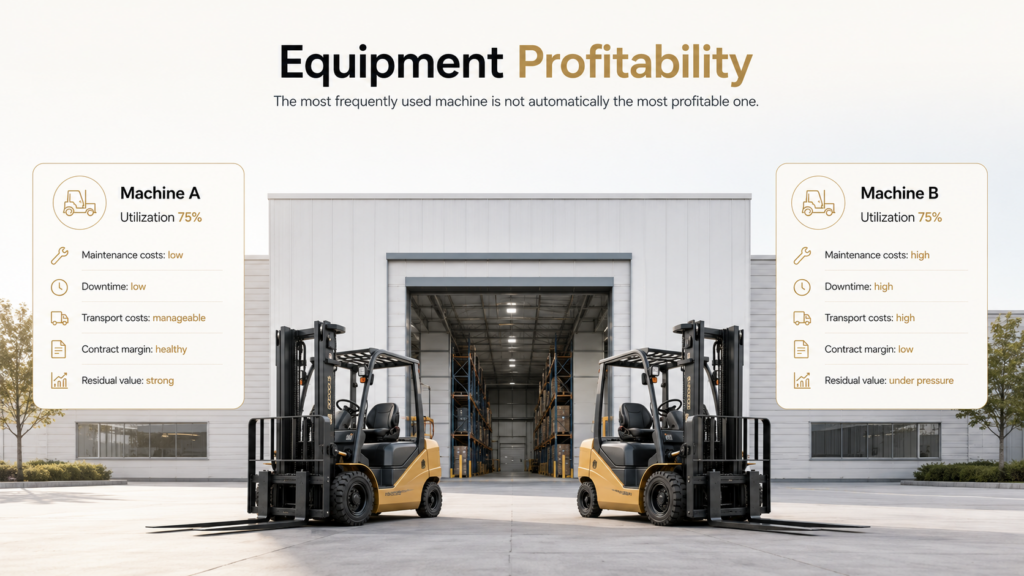
Two machines can both have a utilization rate of 75 percent and still deliver very different financial results.
One machine operates reliably, requires little maintenance and is used under sound contract terms. The other experiences more breakdowns and higher transport costs, while its contract offers little scope to charge for additional work.
On paper, both machines are equally well utilized.
In practice, their margins are completely different.
Why revenue per machine does not provide the full picture
Revenue is visible and relatively easy to measure.
Costs are often spread across different processes and departments.
Rental sees the contract value. Service records maintenance and repairs. The warehouse processes parts. Finance sees depreciation, financing and invoicing. Transport costs may be recorded separately.
If this information is not brought together around the same equipment, a machine can quickly appear more profitable than it really is.
A machine may generate EUR 100,000 in revenue while also incurring an above-average number of repairs, long periods of unplanned downtime, high transport costs or contracts that provide insufficient coverage.
Without a complete view of costs, revenue remains an incomplete indicator.
Which factors determine the true return
1 Rental or deployment revenue
The first component is the revenue generated by the equipment.
This is not limited to the daily, weekly or monthly rate. Additional revenue may also be relevant, including transport, accessories, fuel, cleaning, damage handling, service contracts, extra operating hours and additional support.
The commercial value of a machine often extends beyond the basic rental charge.
2 Availability and downtime
A machine can only generate revenue when it is both available and ready for use.
It is therefore important to distinguish between planned and unplanned downtime.
Planned maintenance may be necessary to prevent larger problems. Unplanned downtime may indicate technical issues, limited parts availability or insufficient maintenance.
Both affect the return, but they require different action.
3 Maintenance and repair costs
Maintenance costs vary according to the type of equipment, its age, how it is used and its operating environment.
An older machine may still generate substantial revenue while becoming increasingly expensive to keep operational.
The relevant question is therefore not only how much it costs to maintain a machine, but:
How are maintenance costs developing in relation to the revenue generated by this specific machine?
This is where the connection with service history becomes important. Our blog about predictive maintenance explains in more detail how historical equipment data can support better maintenance decisions.
4 Transport and logistics
In rental and equipment service, transport costs can have a major impact on the margin.
A commercially attractive contract may disappoint financially if equipment has to be moved frequently, urgent transport is required or planning is inefficient.
If transport costs are not linked to the correct equipment or contract, this effect remains hidden.
5 Damage and return costs
After a rental period, equipment may require additional work before it is ready for use again.
This may include inspection, repairs, cleaning, replacing missing parts or administrative processing.
If these costs are not recorded consistently, equipment profitability will be overstated.
6 Contract terms
Not every rental or service contract delivers the same margin.
A high rate can be eroded by included transport, extensive service terms, free maintenance or limited scope to recharge damage costs.
Equipment profitability should therefore always be assessed together with the commercial terms under which the machine is deployed.
7 Residual value
Equipment profitability does not end when operational use stops.
The final sales proceeds or residual value have a significant impact on the total return over the lifecycle.
A machine that generates slightly less revenue during use may be more financially attractive if it remains reliable and retains its value better.
Decisions about retaining, refurbishing or selling equipment should therefore be based on both historical performance and expected future value.
From utilization to return per asset
Utilization remains relevant, but it becomes more meaningful when combined with financial and technical performance.
Relevant KPIs include:
- revenue per available day;
- margin per rental day;
- maintenance costs per operating hour;
- unplanned downtime;
- total cost of ownership;
- revenue per asset;
- net result per asset;
- expected residual value.
These indicators show whether equipment is not only used frequently but also creates real value.
A simple example
Machine A
- generates stable rental revenue;
- has little unplanned downtime;
- requires limited maintenance;
- is deployed under sound contract terms;
- retains a good residual value.
Machine B
- generates roughly the same rental revenue;
- experiences several technical breakdowns;
- regularly requires urgent transport;
- uses a relatively high number of parts;
- has longer turnaround times between deployments;
- is deployed at a rate that is too low.
Based on utilization, the two machines appear equivalent.
Based on actual profitability, they are not.
Machine B may even make a negative contribution despite its high utilization.
Why asset level information is essential
To measure equipment profitability reliably, revenue and costs must be linked to the correct machine.
That may sound obvious, but in practice the information is often spread across different systems.
Rental works with planning and contracts. Service records work orders. Parts are processed through inventory. Finance sees invoices and cost entries. Equipment history may be stored somewhere else again.
When this information does not come together around the same asset, there is no complete picture.
Decisions are then based on averages and assumptions.
That is why equipment profitability is a logical part of Equipment Life Cycle software. Throughout the full lifecycle, sales, rental, service, maintenance, parts, contracts and financial processing are connected around the same equipment.
Equipment profitability within the Equipment Life Cycle
Equipment profitability is not created within a single department.
Sales determines the initial investment or sales strategy. Rental generates revenue. Service and parts affect availability and costs. Finance processes depreciation, financing and the financial result. The final sale also determines part of the residual value.
Equipment profitability must therefore be assessed across the full Equipment Life Cycle.
Dysel Equipment Life Cycle brings equipment management, rental, service, parts, contracts and financial processing together in a single environment based on Microsoft Dynamics 365 Business Central.
This makes it possible to track revenue, costs and technical history from the same equipment record.
It provides a stronger basis for decisions about:
- rental rates;
- maintenance;
- replacement;
- fleet composition;
- the timing of a sale;
- investments;
- contract terms.
When should a machine be replaced
A machine's age alone is not a good reason to replace it.
An older machine may still be profitable if maintenance costs remain manageable, availability is high and the residual value remains sufficient.
A relatively new machine may underperform if breakdowns, low demand or unfavorable contracts limit the margin.
A replacement decision should therefore be based on several factors, including historical revenue, maintenance costs, breakdown frequency, expected utilization, parts availability, residual value and operational risk.
The question is not only:
How old is this machine?
More importantly:
Does it make economic sense to retain it for longer?
From reviewing results to improving performance
Equipment profitability is not only intended to show after the fact which machines performed well or poorly.
The information should primarily help the business adjust course sooner.
If a particular equipment category has consistently high maintenance costs, this may affect future investments. If contracts do not generate sufficient margin, rates or terms can be adjusted. If downtime is too long, the business can review planning, parts availability or its maintenance strategy.
By connecting revenue, costs and technical history around the same equipment, profitability becomes a management tool rather than just a report.
Profitable equipment requires a complete picture
A high utilization rate is positive, but it tells only part of the story.
Equipment creates real value only when revenue outweighs all costs incurred throughout the full lifecycle.
This requires insight into rental, service, parts, contracts, availability, finance and residual value.
These should not be separate figures, but one connected view per asset.
After all, the most frequently used machine is not automatically the most profitable.
Gain insight into the true return on your equipment
Equipment profitability requires more than insight into utilization and revenue. A reliable view of the true return only emerges when revenue, maintenance costs, parts, downtime, contract terms and residual value are brought together around the same equipment.
Within Dysel’s Equipment Life Cycle software connects this information around each individual piece of equipment. This shows which machines create value, where margins are under pressure and when maintenance, a rate adjustment, replacement or sale is the more logical choice.
Would you like a clearer view of the return per machine? Contact Dysel to arrange an introductory meeting.