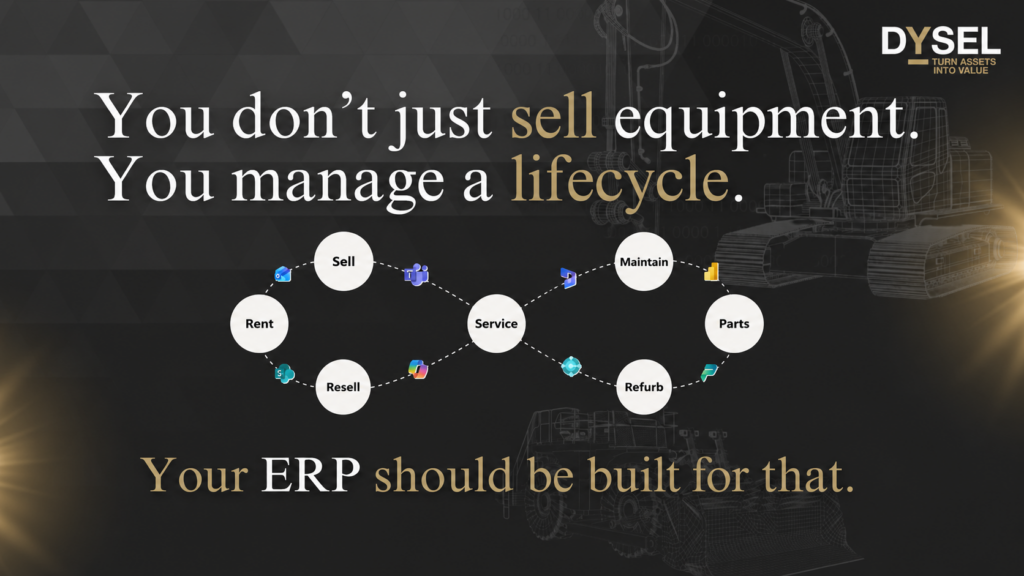
Equipment Life Cycle software helps equipment companies maintain control of machines, vehicles, installations and other equipment throughout the full life cycle.
Equipment companies generate revenue with machines, vehicles, installations and other equipment. That equipment must be available, remain technically reliable, be deployed at the right time and deliver value throughout its useful life.
Whether equipment is sold, rented, leased, maintained or redeployed, the same questions always matter. Where is it? What is its current technical and commercial status? Which agreements apply to it? What costs have been incurred? And what is the logical next step?
Equipment Life Cycle Management therefore focuses on the equipment itself, rather than on any single business process.
Throughout its life, an individual piece of equipment accumulates more and more information. This starts with purchase or intake and continues through sales, rental, lease, service, maintenance, parts consumption, contract terms, damage, downtime and invoicing, through to its eventual sale, replacement or depreciation.
This information affects different departments. Rental needs to know whether equipment is deployable. Sales needs to know what is available or ready for sale. Service needs insight into faults and service history. Maintenance monitors inspections and preventive work. Finance looks at costs, revenue and billability. Management wants to know which pieces of equipment are genuinely profitable.
In many organizations, friction arises precisely between these processes.
A machine may be listed as available in the system even though an inspection is still outstanding. A repair may have been completed, but the costs may not be linked correctly to the relevant equipment. Parts may have been replaced, while their impact on maintenance costs and profitability remains unclear.
Equipment Life Cycle software brings this information together around the same equipment. It is not an additional data capture layer, but an integrated foundation for sales, rental, service, maintenance, contracts, parts, invoicing and reporting.
This provides insight not only into what is happening with equipment today, but also into its full life cycle, cost development and performance.
What is Equipment Life Cycle software?
Equipment Life Cycle software helps companies manage equipment throughout its full useful life.
It connects information from different business processes to the same piece of equipment, including:
- purchase and sales;
- rental and lease;
- location and availability;
- service and repairs;
- preventive maintenance and inspections;
- parts used;
- contractual agreements;
- costs and revenue;
- invoicing;
- reporting;
- replacement, sale and residual value.
The main difference from separate solutions for rental, planning or service is the connection between them.
A service work order is then more than a service record. The work becomes part of the equipment's history and can affect availability, maintenance costs, contract terms, invoicing and, ultimately, the profitability of that equipment.
Equipment Life Cycle Software: 5 Practical Benefits
1. Manage Deployability, Not Just Availability
Availability indicates whether equipment appears to be free.
Deployability indicates whether it is genuinely ready for the next customer, assignment, rental period or sale.
A machine may have been recorded as returned while an inspection is still outstanding. The return check may have identified wear, or additional service may be required. The equipment may also be in a different location from where its next deployment is planned.
Administratively, the equipment is available. Operationally, it is not.
Recording location, technical status, inspections, maintenance, work orders and reservations around the same equipment provides a more realistic picture.
Planning then looks beyond the question "Is this machine available?" and focuses on:
"Is this machine technically, logistically and administratively ready for its next deployment?"
For rental companies, this is an essential part of effective rental software and equipment planning.
2. Less Friction Between Rental, Service and Maintenance
Rental, service and maintenance each view the same equipment from a different perspective.
Rental focuses on customer agreements and deployability. Service deals with faults and repairs. Maintenance monitors inspections, preventive work and technical reliability.
These interests come together, for example, when a customer reports a problem during a rental period while the same machine has already been reserved for the next customer.
Should the equipment be replaced? Can the repair be carried out on site? Does the next reservation need to be adjusted? Are the required parts available? And what does this mean for the customer?
When work orders, maintenance activities, reservations and contract information are linked to the same equipment, it becomes clear more quickly which option makes operational sense.
For the service process itself, this goes beyond recording work performed. In our pillar on Field Service Management for equipment companies you can read how technicians, planning, parts and administration are connected within a single service process.
3. Contract Terms Directly Guide Operations
For equipment companies, contracts are not merely administrative attachments.
They help determine what must happen during the contract term, which work is covered by an agreement, which costs can be charged and what information is needed for invoicing.
For example, periodic maintenance may be included in a service or rental contract, while damage caused by improper use is not.
If a technician identifies damage during a service visit, finance should not be the first department to ask, weeks later, who should bear the cost.
The relevant contract context should be available when the work is recorded and assessed.
Linking the contract, equipment, work order and cost records makes that assessment more consistent.
Service knows which information is required, finance has less reconstruction work to do afterwards, and account or rental management retains a clearer view of the consequences for the customer agreement and financial settlement.
4. Greater Control of Costs Throughout the Full Life Cycle
The value of equipment is not determined solely by sales or rental revenue.
Maintenance, breakdowns, parts consumption, transport, downtime, damage, depreciation, financing and, ultimately, residual value also determine how much value a piece of equipment creates over its useful life.
In many organizations, this data is available but spread across different departments and systems.
Service records a repair. The warehouse processes parts. Finance sees costs and invoices. Rental sees revenue and utilization.
As long as this information is not brought together around the same equipment, it remains difficult to determine which pieces of equipment are truly performing well.
That is why insight at the individual equipment level matters so much.
Two machines can have the same utilization rate and still deliver completely different financial results. One may need little maintenance and operate under commercially sound contract terms. The other may suffer breakdowns, require urgent transport, incur downtime and consume relatively expensive parts.
Read more in Equipment profitability: why a high utilization rate does not automatically mean profit.
Equipment Life Cycle software makes it possible to view revenue, costs and technical history around the same equipment. This supports decisions about maintenance, pricing, replacement, redeployment, investment and the right time to sell.
5. Reporting Based on a Single Operational Truth
Dashboards and reports are reliable only when the underlying information is accurate.
If rental, service, maintenance and finance each work with their own statuses, spreadsheets or corrections, a dashboard can look professional while the underlying picture remains incomplete.
A machine may show a high utilization rate even as maintenance costs continue to rise because of recurring breakdowns.
If utilization, service history, parts, downtime, contracts and financial data are not connected, the true profitability remains hidden.
With an integrated Equipment Life Cycle, this data is built up around the same equipment.
This allows KPIs for deployability, downtime, maintenance costs, utilization and profitability to be viewed in context.
Power BI then becomes an insight layer built on reliable operational data, rather than a tool for piecing fragmented data together after the fact.
From Departmental Data Capture to Managing Each Piece of Equipment
The real change therefore involves more than better software.
It requires a different way of looking at the organization.
In a traditional process, each department maintains its own records. Rental manages contracts and planning. Service manages work orders. The warehouse manages parts. Finance manages costs and invoices.
Yet many of those records ultimately relate to the same equipment.
Using that equipment as the connecting element creates a much more complete picture.
Not only:
What has service done?
or:
How much has rental invoiced?
but:
What has happened to this equipment throughout its full life cycle, and what value has it generated?
That is the essence of Equipment Life Cycle Management.
From Historical Data to Smarter Decisions
A complete equipment history becomes increasingly important as organizations make greater use of automation, dashboards and AI.
Historical maintenance data can help identify recurring faults. Usage data and meter readings can support maintenance scheduling. Cost trends can provide insight into the right time for replacement.
However, these applications are reliable only when the underlying information is accurate.
That is why predictive maintenance, for example, starts not with an algorithm but with a reliable equipment history.
An integrated Equipment Life Cycle ensures that this information does not emerge as a separate dataset, but is generated through the daily processes surrounding the same equipment.
Equipment Life Cycle Management in Dysel ELC
Dysel's Equipment Life Cycle (ELC) is designed for organizations where equipment is central.
Sales, rental, lease, service, maintenance, parts, contract management and finance are supported within a single integrated environment.
ELC is built on Microsoft Dynamics 365 Business Central and connects with the Microsoft Power Platform.
This creates an ERP foundation that combines industry-specific equipment processes with capabilities such as Power BI, Power Apps and Power Automate.
Its strength lies not in the individual technologies, but in the combination of a single reliable operational foundation with additional reporting and automation capabilities.
Equipment at the Center for Better Management
Equipment companies do not ultimately need to collect more information.
They need to connect what they already know more effectively.
Where is the equipment? What has happened to it? Which contracts apply to it? What costs have been incurred? How much revenue has it generated? How reliable has it been? And what is the best next step from an economic perspective?
Equipment Life Cycle software brings these questions together around one central element: the equipment itself.
This gives equipment companies control throughout the full life cycle, from initial deployment to maintenance, rental, service and profitability, and ultimately to sale or replacement.
Would you like to know how Dysel ELC connects sales, rental, service, maintenance, parts and finance around the same equipment? Contact Dysel to arrange an introductory meeting.
Frequently Asked Questions about Equipment Life Cycle Software
What is Equipment Life Cycle software?
Equipment Life Cycle software supports organizations in managing equipment throughout its entire lifecycle. Information from sales, rental, lease, service, maintenance, parts, contracts, and financial processes is brought together around the same equipment.
What is the difference between Equipment Management and Equipment Life Cycle Management?
Equipment Management focuses on managing equipment and its current data and status. Equipment Life Cycle Management takes a broader view of what happens to equipment throughout its entire lifecycle, including deployment, service, maintenance, contracts, costs, revenue, and eventual sale or replacement.
Which processes are part of the Equipment Life Cycle?
Depending on the organization, the Equipment Life Cycle may include purchasing, sales, rental, lease, service, maintenance, inspections, parts management, contract management, invoicing, reporting, and eventual sale or replacement.
Why is the Equipment Life Cycle central to Dysel ELC?
Within Dysel ELC, equipment remains central throughout its entire lifecycle. Sales, rental, lease, service, maintenance, parts, contracts, and financial processes are connected around the same asset. This creates one coherent view of the equipment’s current status, history, costs, revenue, and next steps.
Which companies is Equipment Life Cycle software relevant for?
Equipment Life Cycle software is relevant to organizations where machines, vehicles, installations, or other uniquely managed equipment are central and are sold, rented, leased, maintained, repaired, or redeployed during their lifecycle.