
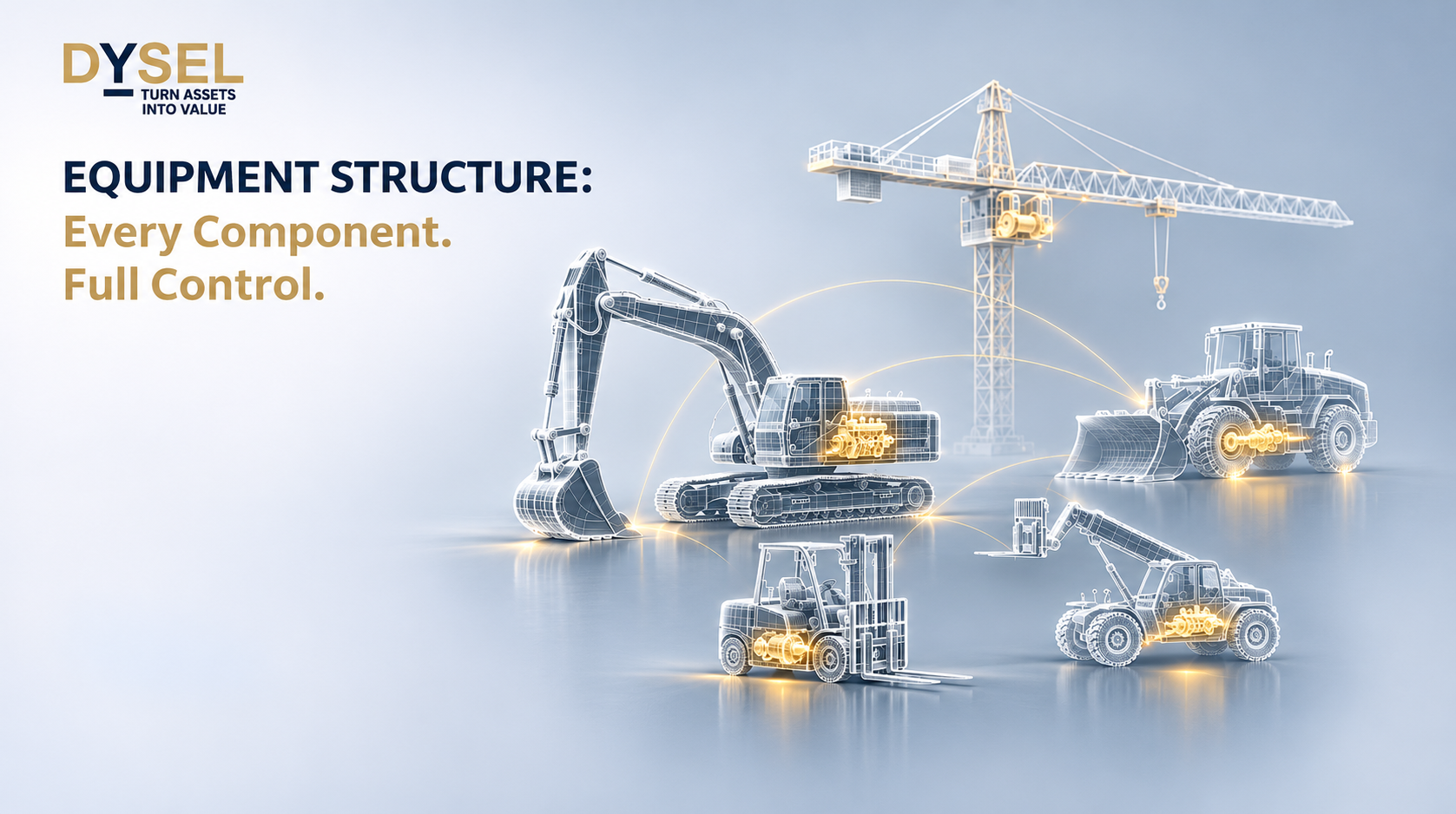
A well-defined equipment structure provides insight into more than just the machines a company owns. Some machines and installations consist of individually identifiable components that together form a complete unit. These might include an engine, drive system, or hydraulic unit with its own serial number and service history.
Those components do not necessarily remain on the same machine throughout their service life. They may be serviced, replaced, or used elsewhere. How can you then tell which components originally belonged to a machine, which ones are currently installed, and where the others have gone?
Equipment Life Cycle Management addresses this by distinguishing between the complete machine, known as the parent equipment, and individually registered components, or child equipment records. The equipment structure captures how they are related.
How Is an Equipment Structure Organized?
An equipment structure starts with the complete machine. Underneath it are the components that need to be tracked individually. This keeps the machine identifiable as a single unit while allowing important components to retain their own identities.
Not every bolt, filter, or standard replacement part needs its own record. Individual tracking is especially useful for components with their own serial numbers, significant value, or specific maintenance, inspection, or warranty requirements. Interchangeability also matters: a component that can be used on multiple machines needs to remain traceable independently of any one machine.
The result is not simply a long parts list, but a clear picture of how a machine is built: which components make up the whole, and which of them need to be managed individually?
Changing Configurations Without Losing Visibility
When a machine is first registered, its component configuration is known. That configuration may change during operation. For example, a drive unit might be removed for repair and temporarily replaced with another. The machine remains the same, but the components installed on it have changed.
This makes two views essential: the original configuration and the current configuration. The first shows how the machine was initially assembled; the second shows which components are actually installed today. Recording installation and removal dates also makes it possible to review earlier configurations.
A component’s relationship to a machine is not the same as its physical location. A removed component may be at an outside repair facility while still being intended for reinstallation on the same machine. A component in the warehouse, on the other hand, may be available for another application. Recording only its location therefore leaves out important context.
Accurate records show which component belonged to which machine and when, where that component is now, and where it is intended to go next. That way, changes in configuration do not result in lost information.
Every Component Has Its Own Technical History
A machine’s maintenance history does not always tell the whole technical story. An installed component may previously have been used on another machine, where it experienced repairs or failures. Those events relate to the component itself, not just to the machine on which it was installed at the time.
When work is recorded only at the machine level, reconstructing that history becomes difficult. Linking maintenance, repairs, failures, and replaced parts to the individual component creates a dedicated technical record. This helps service technicians identify recurring problems and assess whether repair or replacement makes sense.
For components subject to periodic inspections or certification, that independent history is particularly important. Inspection results, certificates, and expiration dates need to stay with the correct physical component, even when it is put into service again. This makes it possible to determine whether the component still meets the applicable requirements and when its next inspection is due.
A complete machine and its components can therefore have different technical life cycles. Distinguishing between the two levels makes maintenance information more accurate and useful.
When Does This Information Really Matter?
The value of a complete equipment structure becomes clear when a company needs to know more than a machine’s current serial number. For a warranty return, for example, a manufacturer may require the machine to be returned with certain original components. In that case, it must be easy to identify those components and find out where they are now. When selling a machine, it is equally important to know which components belong to the unit being delivered.
A recall raises a different question. If a manufacturer recalls a particular series of components, you need to know not only which machines they were originally installed on, but, more importantly, where those components are currently in use. The same traceability supports inspections: the correct certificate must be available for the correct component.
Warranty claims, sales, recalls, and inspections each call for different information. What they share is the need for a reliable connection between a component’s identity, its usage, its location, and its technical record. Employees in the workshop, warehouse, and sales department also need to be able to access the same information as part of their daily work. A component that appears available in the system may already be reserved for a specific machine. When records are maintained consistently, those relationships do not have to be pieced together every time a new question arises.
Equipment Life Cycle Management: Managing Machines and Components
Equipment Life Cycle Management looks at equipment throughout its entire life cycle. For machines with components that need to be tracked individually, this also means understanding how the machine is assembled and the history of the components it contains.
In Dysel’s Equipment Life Cycle (ELC), built on Microsoft Dynamics 365 Business Central, equipment is at the center of operational and financial processes. A well-organized equipment structure provides a foundation for managing machines and their components together.
Want to learn more about this broader approach? Read Equipment Life Cycle Software as the Foundation for Better Asset Visibility.
Conclusion: A Machine Is More Than Its Serial Number
Tracking only the complete machine means missing what happens to its individual components. That distinction matters especially when parts are exchanged, repaired, or put back into service.
A thoughtfully designed equipment structure makes a machine’s configuration verifiable and keeps the technical history of important components accessible. This allows you to make decisions about maintenance, warranties, sales, or recalls based on documented information rather than assumptions.
The principle is simple: know not only which machine you have, but exactly what it consists of—and how that has changed over time.
Would you like to discuss how this could be set up in your organization? Contact Dysel.
Frequently Asked Questions About Equipment Structures
1. What is an equipment structure?
An equipment structure describes how a machine or installation is made up of individual components. The complete machine can be registered as parent equipment, with identifiable components recorded underneath it as child equipment.
2. Why are certain machine components registered individually?
Some components have their own serial number, technical history, or inspection requirements, or can be used on multiple machines. Individual registration makes them traceable.
3. Why is the original configuration important?
For warranty claims or sales, it may be necessary to know which components originally belonged to a machine. The original configuration helps identify and locate them.
4. What happens to a component’s history when it is moved?
The technical history belongs to the physical component. This keeps maintenance, repairs, and inspections visible when the component is used on another machine.