
AI in ERP is rapidly becoming part of the way organizations use their business software. Copilot, AI agents, predictive maintenance, intelligent automation, and generative AI: developments are moving quickly.
But what does AI in ERP actually mean for an equipment company?
For equipment dealers, rental companies, and service organizations, the value of AI does not lie in one smart chatbot or one new feature. The real potential emerges when AI becomes part of the systems and processes people work with every day.
An ERP system contains much of the information needed to run a business: customers, equipment, sales orders, rental contracts, work orders, parts, planning, purchasing, and financial transactions. When that information is reliable and connected, it creates a foundation on which AI can help people find information faster, recognize patterns, prepare work, and further automate processes.
AI in ERP is therefore about much more than Copilot.
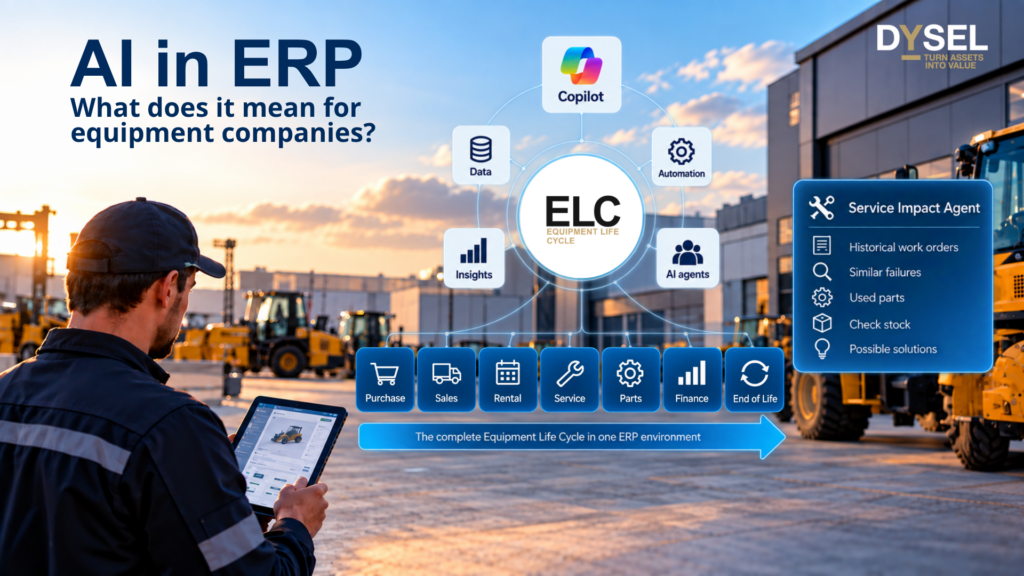
What Is AI in ERP?
AI in ERP means applying Artificial Intelligence within or in combination with ERP software to support users and business processes more intelligently.
It can start very simply.
A user can, for example, request information in natural language, have a record summarized, or get support when analyzing data. But AI can also play a role in identifying anomalies, processing documents, preparing transactions, or carrying out certain process steps.
It is important not to treat all these concepts as if they were the same.
Copilot supports a user in their day-to-day work.
Automation automates predefined steps and rules.
AI can interpret information, identify relationships, generate content, or make suggestions based on the available context.
AI agents go a step further and can perform tasks within defined boundaries, gather information, and prepare or handle process steps.
These capabilities can coexist and reinforce one another.
The question is therefore not only: What can AI do?
A much more important question is: where can AI actually add value within our business processes?
Why Is ERP So Important for AI?
AI becomes truly interesting when it has access to relevant context.
A general AI solution can, for example, explain how a maintenance process normally works. But supporting a service employee in practice requires different information.
Which equipment is involved? Which failures have been reported before? What work has been carried out? Which parts were replaced? How many operating hours does the machine have? Which contractual agreements apply? Is maintenance already scheduled? And what is the impact on availability, planning, and invoicing?
Much of that information is created within ERP and related business systems.
For equipment companies, this connection is especially important because a single machine moves through multiple processes during its lifetime. Equipment is purchased, sold, rented or leased, maintained, repaired, moved, and ultimately replaced or resold.
During that Equipment Life Cycle, new information is continuously created.
The better that information is connected, the more context becomes available for analysis, automation, and AI.
AI Within the Microsoft ERP Landscape
Dysel’s Equipment Life Cycle (ELC) is built on Microsoft Dynamics 365 Business Central. This means ELC is directly connected to the broader developments Microsoft is making in AI.
Business Central already includes various AI and Copilot capabilities. Microsoft is also continuing to expand these capabilities with AI agents that not only present information, but can also perform tasks within business processes.
That is why it is useful to view AI in ERP not as a single feature, but as a landscape that continues to evolve.
Copilot: AI Alongside the User
Copilot is probably the most recognizable form of AI within the Microsoft landscape today.
Within Business Central, Copilot can support users in a range of everyday activities. The user remains central: AI helps find, analyze, summarize, or create information while the employee continues to work in the system.
This makes Copilot particularly relevant for activities where employees spend a lot of time searching, interpreting, entering, or summarizing information.
But Copilot is only one part of the development. In our article From Copilot to ERP Agents: What Will AI Mean for Equipment Dealers in the Future? we explore the shift from AI as an assistant to AI becoming increasingly embedded in operational processes.
AI Agents: From Supporting to Executing
AI agents add another dimension.
Where a user typically asks Copilot for support, agents can independently perform certain tasks within defined boundaries and involve the user when review or a decision is required.
Microsoft now provides standard agents within Business Central.
The Sales Order Agent supports the sales order process. It can analyze customer requests from email, identify the customer in Business Central, request missing information, check availability, and prepare a sales quote or sales order depending on the configuration.
The Payables Agent is also part of the Business Central landscape. It focuses on processing incoming vendor invoices and can analyze invoice information and prepare draft documents for further review.
These standard agents mainly illustrate the direction of travel: AI in ERP is no longer only about providing answers. AI can increasingly play a role in preparing and carrying out work.
Standard AI Versus Industry-Specific AI
Microsoft’s standard capabilities are relevant to organizations across many industries.
Equipment companies also have processes where specific knowledge about machines, failures, maintenance, parts, rental, and service plays an important role.
That creates opportunities for industry-specific AI applications.
Within Dysel, for example, work is being done on the Service Impact Agent for ELC. This agent is designed to support the service process when a machine failure is reported.
The Service Impact Agent can examine historical work orders to determine whether a similar failure has occurred before. How was that failure resolved? Who worked on it? Which parts were used? And are those parts currently in stock?
Based on previous solutions, the agent can bring together relevant information and possible solution paths. If multiple solutions frequently occur for similar failures, that information can also be used during preparation to take into account the parts or materials required for an alternative solution.
This means the technician starts not only with a failure report, but with relevant knowledge from previous service work.
In a future article, we will take a closer look at AI agents and their potential role within ERP and equipment management.
AI Across the Equipment Life Cycle
The Equipment Life Cycle offers many opportunities for AI.
Throughout the lifetime of an asset, an equipment company collects information about, among other things:
- purchase and configuration;
- sales and rental;
- availability and deployment;
- inspections and maintenance;
- failures and repairs;
- parts used;
- meter readings and usage;
- contractual agreements;
- costs and revenue;
- invoicing;
- residual value and sale.
Individually, these are data points.
Together, they create context.
That context can help people find relevant information faster, make anomalies visible, recognize similar situations, and support employees in determining the next step.
But the value goes beyond day-to-day operations. When technical history, usage, costs, revenue, maintenance, and deployment remain connected throughout the equipment lifecycle, this also creates information that can support future investment decisions.
Which types of equipment perform well? Where are maintenance costs increasing? Which machines deliver the desired return over their lifetime? And when does replacement or sale become more attractive than continued investment?
AI can help reveal more and more relationships within this information. That does not mean AI should automatically make the decision. Within equipment companies, experience, exceptions, and operational knowledge remain important.
The value lies in making better use of the information built up throughout the complete Equipment Life Cycle.
From Reactive to Increasingly Predictive
One of the most widely discussed applications of AI in equipment management is predictive maintenance.
The idea is attractive: instead of waiting for equipment to fail, historical and current information can be used to identify earlier when maintenance is likely to be needed.
But prediction does not start with AI.
To recognize patterns, you first need to know what has happened to the equipment before. Failures, repairs, parts used, maintenance intervals, meter readings, and usage must be recorded reliably enough.
That is why predictive maintenance starts with a good equipment history.
In the article Predictive Maintenance Starts With the History of Your Equipment, we take a closer look at this development and explain why reliable equipment data is the first prerequisite for predictive maintenance.
AI and Automation Are Not the Same
The attention around AI can sometimes create the impression that every process should now be solved with AI.
That is not necessary.
Many business processes consist of predictable steps. When it is clear in advance what needs to happen and under which conditions, traditional process automation can be highly effective.
With Microsoft Power Automate, for example, workflows can be configured based on events, conditions, and predefined actions.
AI becomes more relevant when information first needs to be interpreted, when patterns or anomalies matter, or when not every situation can be fully captured in rules beforehand.
In practice, the two will increasingly be used side by side.
A process can begin with a fixed workflow, use AI to interpret information, and then trigger another automated action.
So the question is not: AI or automation?
The question is which technology is the best fit for the task at hand.
We will explore this topic in more detail in a future article as well.
Data Determines How Useful AI Can Be
No matter how advanced AI becomes, the quality of its output still depends on the information available.
This is particularly important within ERP.
If the same machine is registered differently in multiple systems, contract information is missing, service history is incomplete, or parts are not linked to the correct equipment, part of the context is missing.
AI cannot simply reconstruct that missing business reality.
In fact, a confidently worded answer based on incomplete information can create additional risk if users assume the answer is complete and correct.
That is why a good AI strategy does not start with choosing an AI tool.
It starts with processes, data quality, and connected information.
This is also an important principle behind Dysel’s Equipment Life Cycle. Instead of treating equipment only as master data, different operational and financial processes around the same equipment are supported within one ERP environment. This allows an increasingly complete picture of the equipment to develop throughout its lifecycle.
Read more about the importance of reliable data in Why Data Quality Is the Foundation of Reliable Business Intelligence and Field Service Management in the Future: Data Becomes the Foundation of Smart Service.
From Data to Insight, Automation, and AI
AI therefore does not stand on its own.
Reliable data enables better analysis. Better analysis creates insight. Structured processes can be automated further. And as more reliable context becomes available, new opportunities to apply AI emerge.
This also means that not every organization needs to start at the same point.
For one organization, better management information may deliver more value today than an AI agent. For another, automating repetitive administrative work may be the logical next step. And in processes where a great deal of information needs to be interpreted, AI may be particularly relevant.
Technology is developing quickly, but the sequence still matters.
A smart application on top of a weak information foundation does not make that foundation stronger.
The Strength of ELC Within an Increasingly Intelligent Microsoft Platform
Dysel does not need to build its own alternative to Microsoft’s AI platform.
ELC is built on Microsoft Dynamics 365 Business Central and is therefore part of a platform in which Microsoft continuously develops new capabilities in AI, Copilot, agents, data, and automation.
The strength of ELC lies in its industry-specific context.
Dysel’s Equipment Life Cycle supports the processes that arise throughout the lifetime of equipment and brings operational and financial information around that equipment together within the same business environment.
That is important for day-to-day operations today.
But that same context becomes increasingly valuable as software becomes more intelligent.
An AI application that only knows general information can provide general support. An application that also has access to relevant equipment history, work orders, parts, contractual agreements, and financial context can provide much more targeted support.
This is where a significant part of the future potential of AI in ERP lies for equipment companies: not only smarter technology, but smarter technology with access to the right business context.
AI in ERP Is Only Just Beginning
The development of AI within ERP is moving quickly.
Functionality that seemed futuristic only a few years ago is now part of everyday business software. At the same time, many applications are still at an early stage, and Copilot, agents, automation, and traditional ERP functionality will continue to converge.
For equipment companies, this creates interesting opportunities.
But the best preparation for that future is not to implement every new AI feature immediately.
It is to build a strong digital foundation: reliable processes, good data, connected information, and an ERP landscape that can evolve with new technology.
From there, organizations can continue to determine where AI actually adds value.
In future articles, we will therefore explore individual topics such as Copilot, AI agents, automation, predictive maintenance, and AI within specific equipment processes.
Because AI in ERP is not a standalone feature that an organization implements once.
It is a development that is gradually changing ERP from a system in which information is recorded into a platform that can increasingly help employees understand and use that information.
AI and ERP Within Dysel ELC
Dysel helps equipment companies connect processes and information throughout the complete Equipment Life Cycle.
With ELC, built on Microsoft Dynamics 365 Business Central, an integrated foundation is created in which operational and financial information around equipment comes together.
That foundation is needed today to support operations effectively and is becoming increasingly important for the AI capabilities of tomorrow.
Would you like to know what developments around AI, Copilot, and agents could mean for your equipment company? Contact Dysel to discuss the possibilities.
Frequently Asked Questions About AI in ERP
What Is AI in ERP?
AI in ERP means applying Artificial Intelligence within or in combination with ERP software. AI can help users search, summarize, and analyze information, but it can also be used to interpret data, make suggestions, and support or automate certain process steps.
Is Copilot the Same as AI?
No. Copilot is an application of AI that supports users in their work. AI is a much broader concept and includes generative AI, pattern recognition, predictions, and AI agents.
What Is the Difference Between Copilot and an AI Agent?
Copilot generally supports a user who is actively working in the system. An AI agent can also perform tasks independently within predefined boundaries and involve the user when review or a decision is required. Microsoft now provides standard agents within Business Central, including the Sales Order Agent and Payables Agent.
What Can AI Mean for Equipment Companies?
AI can support equipment companies in finding and interpreting information, recognizing patterns and anomalies, and preparing work and decisions. The opportunities increase when information about equipment and the processes around it is well connected.
Can AI Enable Predictive Maintenance?
AI can play a role in predictive maintenance by identifying patterns in historical and current information. This does require a reliable equipment history containing, for example, maintenance, failures, parts consumption, meter readings, and usage information.
Is Good Data Essential for AI in ERP?
Yes. AI needs reliable and relevant information to provide useful support. Incomplete, outdated, or fragmented ERP data limits the context AI can work with and can therefore also reduce the reliability of its output.
Does Business Central Already Have AI Functionality?
Yes. Microsoft Dynamics 365 Business Central includes various Copilot and AI capabilities. Microsoft also provides standard AI agents, including the Sales Order Agent and Payables Agent. Availability and conditions for specific AI functionality may depend on factors such as release, region, licensing, and configuration.
Will AI Replace Employees in an Equipment Company?
AI can support employees with information processing, repetitive work, and identifying relevant signals. In equipment processes, operational knowledge, exceptions, customer agreements, and human judgment remain important.