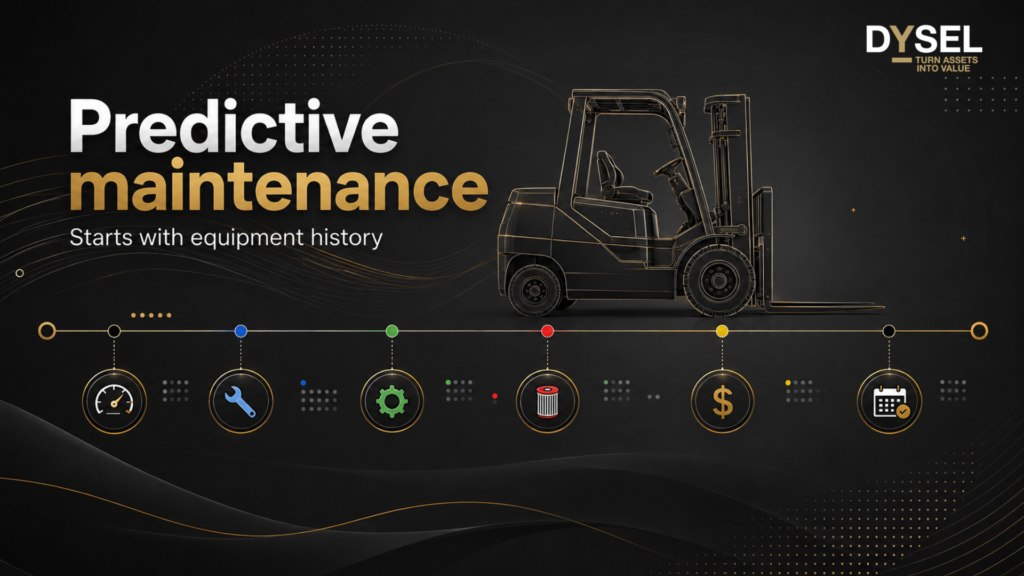
Predictive maintenance sounds attractive.
Predict maintenance before downtime occurs. Recognize failures earlier. Have spare parts available on time. Plan mechanics more intelligently. Utilize equipment better.
For equipment companies, that's a logical ambition, because downtime costs money.
Unexpected repairs disrupt planning. Missing parts delay service. Furthermore, customers increasingly expect a dealer not only to react when something breaks, but to proactively think about operational readiness, maintenance, and costs.
However, predictive maintenance usually doesn't start with sensors, algorithms, or AI.
It starts with the foundation: the history of your equipment.
Predictive maintenance is not a starting point
Many conversations about predictive maintenance start on the wrong foot: with the technology.
Sensors, telematics, dashboards, AI models, and smart predictions are valuable, but only when the underlying information is reliable.
An organization can only predict what is likely to happen once it is clear what has happened before.
How was an object used? What malfunctions were reported? What maintenance work was performed? What parts were replaced? What costs were incurred? What contract agreements were in effect at that time? And what was the impact on availability, scheduling, and invoicing?
Without that history, predictive maintenance remains largely a beautiful promise.
The history of equipment is often fragmented
Many equipment companies have information about equipment, but it's scattered across different systems, departments, and records.
A breakdown is in a work order. An important note is in a free text field. Parts consumption is registered in the ERP system, but not always correctly linked to the right object. Operating hours come from telematics, from manual registration, or are only recorded during a subsequent maintenance. Contractual agreements are located elsewhere. Finance often only sees the consequences during invoicing.
Each department knows part of the story, and as long as employees can make the missing connections themselves, the process seems to work. However, knowledge in people's heads is not a reliable basis for predictable maintenance.
When information is not structurally recorded and connected, maintenance remains dependent on experience, checks, and correction work.
Prediction requires context
Predictive maintenance isn't just about when an asset needs maintenance.
Context determines whether information truly gains meaning.
A failure says little if it's unknown how intensively the object was used. Parts consumption says little if it's unclear why a part was replaced. Costs are difficult to assess when they are not linked to the correct object, contract, or type of work.
If a component wears out faster than expected, you'll want to be able to investigate whether this is related to usage, maintenance intervals, machine configuration, or deployment at the customer's site. You also want service, planning, and parts to be able to respond to this in a timely manner.
If certain costs repeatedly occur within the same asset group, you'll want to be able to assess what this means for contract agreements, margins, and future service planning. That context makes information useful for analysis and for daily operations. That's where predictability begins: not with a magic model, but with reliable information surrounding the equipment.
Maintenance is never an isolated task
Within equipment companies, maintenance almost always affects multiple processes.
A service notification affects planning. The availability of parts determines whether work can be performed immediately. Contractual agreements determine what is and isn't charged. The object's availability has consequences for rentals, service agreements, and customer satisfaction. Finance then needs reliable data to invoice correctly.
When these processes function independently, noise arises. That disrupts daily operations and limits the possibilities for predictive maintenance.
Predictive maintenance, therefore, is not just about recognizing what is likely to happen. It is also about whether the organization is prepared for it and can actually act on it.
The Equipment Life Cycle as a Foundation
For equipment companies, an object is never just an object. It has a full lifecycle.
It is sold, leased, maintained, repaired, moved, redeployed, and eventually replaced or resold. During that lifecycle, valuable information is continuously generated about usage, availability, failures, maintenance, parts, contracts, costs, and customer agreements.
The way this information is recorded and connected determines how well an organization can steer.
Dysel’s Equipment Life Cycle (ELC) software is developed for companies where equipment is central. The solution is built on Microsoft Dynamics 365 Business Central and supports processes related to equipment, service, rental, lease, parts, contracts, finance, and reporting from one integrated base.
This makes predictive maintenance more realistic. Not because software can suddenly predict everything, but because the information needed to recognize patterns is recorded more reliably and is more readily available within the daily process.
When the history of equipment is complete and connected, a stronger foundation is created for analysis, reporting, and future AI applications. Recurring failures become more visible, maintenance can be better planned, and service information no longer needs to be reconstructed retroactively.
Predictive maintenance thus becomes not a separate technology project alongside the ERP system, but a logical next step within the Equipment Life Cycle.
The sober route to smarter maintenance
When the foundation is not sound, predictive maintenance becomes vulnerable.
Analyses, dashboards, and AI models are then built on incomplete, fragmented, or incorrectly linked information. The outcome may appear convincing, yet it may not be reliable enough to base operational decisions on.
That's why the down-to-earth path to predictive maintenance doesn't start with predicting.
It starts with better recording.
Object information in order. Service history consistently recorded. Parts consumption linked to the correct equipment. Contractual agreements visible within the process. Costs and invoicing connected to the performed work.
That sounds less spectacular than predictive maintenance, but it's precisely the foundation on which reliable predictions must later be built.
There lies the role of Dysel.
Not by promising that everything will automatically become predictable, but by helping equipment companies connect their processes and data so that maintenance becomes smarter, more plannable, and better manageable.
Conclusion: better prediction starts with better understanding
Predictive maintenance is innovative, but its true value doesn't begin with the prediction itself.
This starts with understanding what happened to your equipment previously.
How it was used. What malfunctions were reported. What work was performed. What parts were replaced. What agreements were in place. What costs were incurred. And what impact this had on scheduling, availability, and invoicing.
Without that foundation, predictive maintenance will remain largely an ambition.
The first step is therefore not complex technology.
It starts with the Equipment Life Cycle.
Would you like to plan maintenance smarter and utilize equipment information better? Dysel helps equipment companies connect equipment history, service data, parts consumption, and contract information within one Equipment Life Cycle.
Please contact us to discuss the possibilities.