Data-driven Field Service Management is playing an increasingly important role within service organizations. While the traditional focus was mainly on scheduling technicians, processing work orders, and recording maintenance, data is becoming increasingly important in determining more quickly and effectively what is needed.
Service organizations have access to an ever-growing amount of information about their equipment. This includes breakdowns, maintenance, repairs, parts used, meter readings, service contracts, and previous work orders.
When this information is recorded properly and connected, it creates a valuable foundation for smarter service.
The smarter service processes become, the more important the quality of the underlying data becomes. Without a complete equipment and service history, even the smartest technology lacks the context needed to support good decisions.
What is Data-Driven Field Service Management?
Data-driven Field Service Management means that service decisions are based not only on the current service request or an employee’s experience, but also on available historical and operational data.
When a breakdown occurs, for example, what the customer reports at that moment is not the only relevant information. Previous repairs, recurring breakdowns, parts used, machine configuration, and maintenance history may also provide valuable context.
Bringing this data together creates more context. And that context is exactly what makes it possible to support employees more effectively and further optimize service processes.
Equipment as the Central Information Point
Throughout the entire lifecycle of a machine or other equipment, new information is continuously generated.
A machine may be sold, rented, or leased. Maintenance is then carried out, parts are replaced, breakdowns are reported, and work orders are completed. Service contracts may be linked to the equipment, and usage data or meter readings may be recorded.
When this information is spread across different systems, documents, or individual employees, some of that knowledge remains difficult to access.
A service technician may see the current work order, but not immediately know which problems have occurred previously with the same machine. A planner knows which technician is available, but may have less insight into which technical expertise is relevant to a specific breakdown.
That is why a central view of the equipment is becoming increasingly important. The current service request then no longer stands on its own, but becomes part of the complete history of the equipment.
Why Is Service History So Valuable?
A good service history makes it possible to reuse previous experience.
Suppose a service request comes in for a machine with a particular breakdown. When sufficient historical data is available, it is possible to see whether the same problem has occurred before.
Not only on that specific machine, but potentially on similar equipment.
This raises questions such as:
- What work was carried out at the time?
- Which parts were used?
- Which solution proved successful?
- How often has the same breakdown occurred before?
- Was another service request reported after the repair?
- Which technician or technical expertise was involved in resolving the issue?
The more readily this information is available, the faster a service organization can move from a service request to a well-founded next step.
More Data Does Not Automatically Mean Better Data
Collecting large amounts of service data is not enough on its own.
The quality of the data ultimately determines how much value can be extracted from it.
When breakdowns are described differently each time, work is not recorded consistently, or parts used are missing from the service history, it becomes more difficult to identify patterns.
Data quality therefore becomes an important part of Field Service Management.
The issue is not only how much data an organization collects, but above all whether that data:
- is complete;
- is reliable;
- is recorded consistently;
- is organized around the correct equipment;
- is accessible to other processes and applications.
The stronger this foundation, the greater the opportunities to support service employees.
From Searching for Information to Having Information Delivered
Many service organizations already have valuable information. The problem is often that employees have to find it themselves.
A service employee searches through old work orders. A technician reviews previous reports. A planner asks an experienced colleague whether a particular breakdown looks familiar.
With well-structured equipment and service data, that process can change.
For a new service request, relevant information can, for example, be made available immediately. This could include similar breakdowns from the past, previous solutions, or parts used in comparable repairs.
Based on this, a system can increasingly provide support in the future with questions such as:
What is likely happening here? Which solution worked before? Which parts might be needed? What is the most logical next step?
Technology then shifts from simply recording information to actively supporting employees.
Data Forms the Foundation for Further Automation
Automation and more intelligent support do not start with the technology itself.
They start with available context.
When a system has reliable information about equipment, service history, parts, work performed, and previous solutions, many more possibilities become available.
A system can, for example, help identify recurring breakdowns, find relevant previous cases, suggest likely parts, or prepare information for a new work order.
Other scenarios are also possible. These include identifying unusual maintenance patterns, supporting planning, or making technical knowledge more readily available to service technicians.
The technology used for this may change. The underlying requirement remains the same: without good data, intelligent support is limited.
Why Integrated Equipment Data Is Becoming Increasingly Important
For equipment companies, service is usually only one part of the overall process.
Throughout the equipment lifecycle, data is generated within sales, rental, lease, service, maintenance, parts management, contracts, and financial processes.
When this data is connected, it provides more insight than looking only at individual service work orders.
A recurring breakdown, for example, may not only be technically relevant, but may also affect maintenance costs, availability, and total costs over the equipment lifecycle.
Data-driven Field Service Management therefore becomes part of a broader Equipment Life Cycle process.
It is not only the question:
“How do we resolve this breakdown?”
but ultimately also:
“What do we know about this equipment, and how can we use that knowledge to make better decisions?”
Data-Driven Service as the Next Step in Field Service Management
Good data does not exist in isolation. It is created because service, equipment, maintenance, parts, and other processes are connected.
That is why data-driven service is a next step within a broader Field Service Management process.
Would you like to know more about how planning, service, equipment, parts, and administration come together in this process? Read our main article, Field Service Management for Equipment Companies: From Work Order to Integrated Service.
Smarter Service Starts with a Strong Data Foundation
Developments in AI and automation often focus on what new technology can do.
For service organizations, other questions are at least as important.
Do we know what has happened to the equipment before? Is work recorded properly? Is it clear which parts were used? Can similar situations be found? And is data from different processes connected?
When that is the case, a strong foundation is created for increasingly intelligent support.
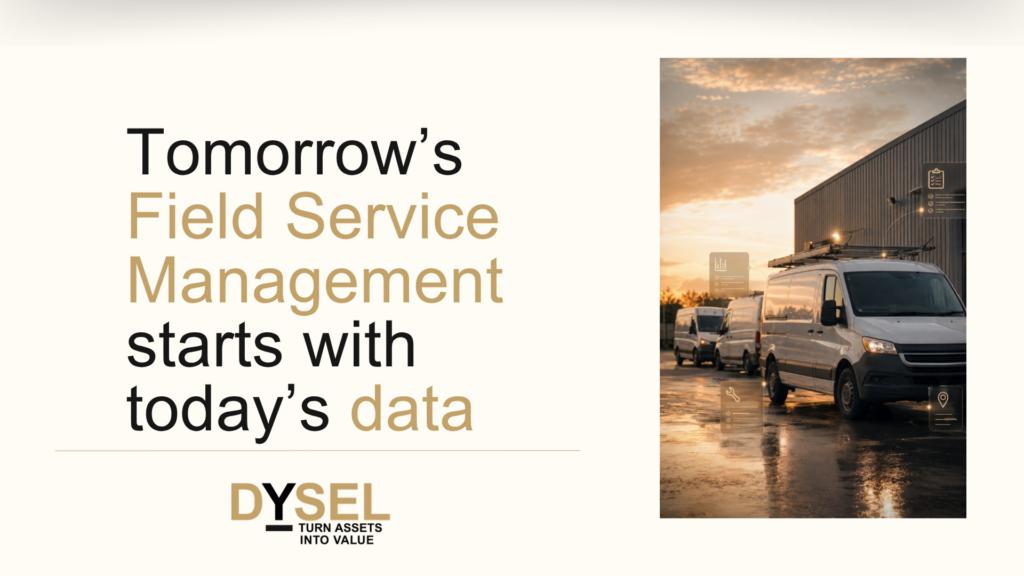
Tomorrow’s Field Service Management Starts with Today’s Data
Field Service Management will continue to evolve. Technicians, planners, and service employees can increasingly be supported in finding information, identifying patterns, and preparing actions.
Organizations that truly want to benefit from this need to start thinking today about the quality and connectivity of their data.
Within Dysel’s Equipment Life Cycle (ELC) , equipment is central to the different business processes.
Dysel ELC is built on Microsoft Dynamics 365 Business Central and connects with the Microsoft Power Platform. This makes it possible to build up information from service, maintenance, parts, rental, lease, and other processes around the same equipment.
This not only provides insight into the past, but also forms the foundation for supporting service processes more intelligently in the future.
Would you like to know more about how Dysel ELC, Dysel Field Service, and Equipment Management are supported within one integrated environment? Contact Dysel to arrange an introductory meeting.
Frequently Asked Questions about Equipment Life Cycle Software
What is Equipment Life Cycle software?
Equipment Life Cycle software supports organizations in managing equipment throughout its entire lifecycle. Information from sales, rental, lease, service, maintenance, parts, contracts, and financial processes is brought together around the same equipment.
What is the difference between Equipment Management and Equipment Life Cycle Management?
Equipment Management focuses on managing equipment and its current data and status. Equipment Life Cycle Management takes a broader view of what happens to equipment throughout its entire lifecycle, including deployment, service, maintenance, contracts, costs, revenue, and eventual sale or replacement.
Which processes are part of the Equipment Life Cycle?
Depending on the organization, the Equipment Life Cycle may include purchasing, sales, rental, lease, service, maintenance, inspections, parts management, contract management, invoicing, reporting, and eventual sale or replacement.
Why is the Equipment Life Cycle central to Dysel ELC?
Within Dysel ELC, equipment remains central throughout its entire lifecycle. Sales, rental, lease, service, maintenance, parts, contracts, and financial processes are connected around the same asset. This creates one coherent view of the equipment’s current status, history, costs, revenue, and next steps.
Which companies is Equipment Life Cycle software relevant for?
Equipment Life Cycle software is relevant to organizations where machines, vehicles, installations, or other uniquely managed equipment are central and are sold, rented, leased, maintained, repaired, or redeployed during their lifecycle.